
_edited.png)
How Does EMDR Therapy Work? A Practical Guide to Trauma Healing

It takes real courage to start searching for a path toward healing, so the fact that you’re even reading this is a huge first step. If you’ve heard of Eye Movement Desensitization and Reprocessing (EMDR) therapy, you might be curious about what it is and how it actually works. We're so glad you're here to learn more from Rise Counseling and Coaching LLC- a mental health practice that specializes in EMDR and trauma counseling.
Put simply, EMDR is a well-researched approach that uses bilateral stimulation—things like guided eye movements or tapping—to help your brain reprocess memories that have gotten “stuck.” I often tell clients to think of it like finally organizing a seriously messy closet. EMDR helps your brain take out those painful experiences, refold them, and file them away properly so they stop spilling out and disrupting your day-to-day life.
Your Path to Healing Begins with Understanding EMDR

When you're carrying the heavy weight of trauma or constant distress, it's completely normal to feel a little lost or overwhelmed by all the therapy options out there. Maybe you've already tried other things that didn't quite help, or you've just been hoping that time would make things better on its own. This guide is here to cut through the confusion and give you a clear, hopeful picture of what EMDR can do.
Unlike traditional talk therapy, which often involves going over events in great detail, EMDR works with your brain’s incredible, natural ability to heal itself. We all have this built-in capacity. But sometimes, a traumatic event is just too big, too shocking, or too painful for our minds to handle, and it gets frozen in time. That’s why the memory can feel just as raw and intense as the day it happened.
What Makes EMDR Different?
EMDR is a structured therapy designed to get those memories "unstuck." It doesn't erase your past—that's not the goal. Instead, it fundamentally changes how the past lives inside of you. The aim is to be able to remember what happened without having to relive the gut-wrenching emotional and physical sensations that have been attached to it for so long. For many people, this process brings a sense of relief much more quickly than they ever thought possible.
This unique way of working offers some really key benefits:
It dials down the emotional volume. EMDR helps neutralize the intense distress tied to traumatic memories.
You don’t have to talk for hours. For many, it’s a huge relief that you don't need to describe your trauma in exhaustive detail to get results.
It’s brain-based healing. The process taps into your mind's own information-processing system to finally integrate those difficult experiences.
The best way to think about it is this: EMDR gives your brain a second chance to finish the processing work it couldn't complete when the trauma first happened. It’s all about creating new, healthier connections so the memory no longer has control over your present.
A Safe Space for Your Journey
Making the choice to start therapy is a powerful act of self-care, and you deserve a place where you feel completely safe to do that work. At Rise Counseling and Coaching, we’re committed to providing a supportive, non-judgmental space where you can feel secure enough to explore your experiences.
EMDR is one of several highly effective therapeutic approaches we use, because we know that the best care is care that’s right for you. We get that you have questions, and we’re here to answer every single one. Hopefully, this guide gives you a clear and hopeful look at what’s possible.
Take a moment and just acknowledge the strength it took to get here. When you’re ready, our door is always open. We warmly invite you to schedule a free consultation to ask a question or just see if we're a good fit.
How EMDR Helps Your Brain Reprocess Difficult Memories
To really get what’s happening in EMDR therapy, we first need to talk about how your brain is supposed to handle experiences. The theory behind EMDR is called the Adaptive Information Processing (AIP) model. It’s a fancy name for a simple idea: your brain has a natural, built-in system for processing information, much like your body knows exactly how to heal a cut.
Most days, this system works like a charm. It takes in what happens, pulls out any lessons, and neatly files the memory away. But when something traumatic or deeply upsetting happens, that system can get completely overwhelmed and go temporarily offline. The experience is just too much, too fast, or too scary your brain shifts to focusing on physical survival.
Instead of getting processed and filed away as a past event, the memory gets “stuck.” All the sights, sounds, emotions, and even physical sensations from that moment are frozen in time, locked in their original, raw form. This is why a trigger in the present can make it feel like you’re right back there, reliving the whole thing. It doesn’t feel like a memory; it feels like it's happening now.
Getting Traumatic Memories “Unstuck” with EMDR
So, how does EMDR help get these memories unstuck? Imagine a traumatic memory is like a deep scratch on a vinyl record. Every time the needle hits that scratch, the song gets stuck, playing the same painful part over and over. You can’t move on, and you’re trapped in that loop.
Bilateral stimulation—the guided eye movements, taps, or sounds we use in an EMDR session—is like a steady, gentle hand that helps guide the needle past that scratch. It doesn't erase the memory (the scratch is still there), but it helps your brain’s processing system get past the point where it was stuck and finally do its job.
The goal of EMDR is not to forget what happened, but to change how you remember it. It helps your brain re-file the memory as something that is firmly in the past, removing the intense emotional and physical charge that made it so painful.
This allows the memory to be woven into your larger life story in a way that’s no longer disruptive. You can acknowledge what happened without being hijacked by the original terror, grief, or helplessness. The memory becomes just that—a memory—instead of a painful, constant presence in your daily life.
EMDR vs. Traditional Talk Therapy: A Snapshot
While both EMDR and traditional talk therapy are powerful tools for healing, they work in very different ways. Looking at the differences can help you understand why EMDR might be the right fit for you, especially when dealing with experiences that are hard to talk about.
Here’s a quick comparison:
Aspect | EMDR Therapy | Traditional Talk Therapy |
Primary Focus | Processing memories internally using bilateral stimulation to reduce their emotional intensity. | Verbal exploration of thoughts, feelings, and events to gain insight and develop coping strategies. |
Talking About Trauma | Does not require detailed, prolonged verbal descriptions of the traumatic event. The focus is on the internal experience. | Often involves talking through the traumatic event in detail to process emotions and challenge beliefs. |
Client Role | The client's brain does the healing work, with the therapist facilitating the process and ensuring safety. | The therapist often takes a more active role in guiding the conversation, interpreting, and providing feedback. |
Ultimately, EMDR creates the conditions for your own brain to do the healing. It trusts in your mind’s incredible capacity to recover, which has been there all along. The whole process is about helping you move from a state of "I am in danger" to a settled, grounded feeling of "I was in danger, and I am safe now."
Action Item: This week, just gently notice—without any judgment—if certain situations, people, or thoughts trigger a surprisingly strong emotional or physical reaction for you. This simple awareness is a wonderful first step in understanding what your nervous system might be holding onto. If you’re curious about how this process could help you, we warmly invite you to reach out on our contact page to ask questions or schedule a free consultation.
Your Step-by-Step Guide to the Eight Phases of EMDR- How EMDR Therapy Works
One of the best things about EMDR is that it isn’t some mysterious, unpredictable process. Far from it. It’s a thoughtful, highly structured journey that follows a clear, eight-phase roadmap. Each step has a specific purpose, building on the last to make sure you feel safe, prepared, and in the driver's seat the entire time.
Think of it this way: you wouldn't build a house by putting up the walls before you've poured a solid foundation. EMDR works the same way. We build a secure and effective path toward healing, one logical phase at a time.
This diagram gives you a great visual of what we’re aiming for—taking a difficult, "stuck" memory and helping your brain fully process it.
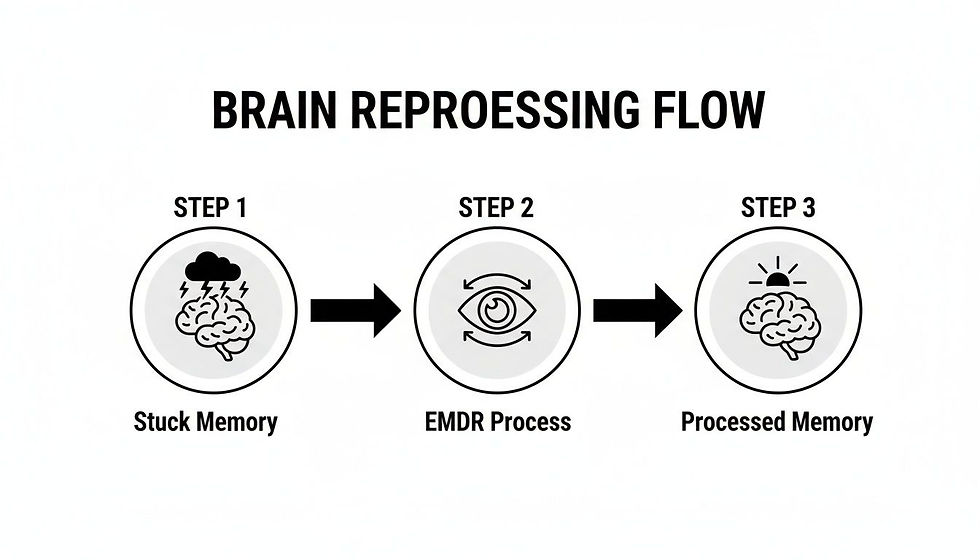
You can see how the distressing "storm cloud" of a memory is transformed into something more like a peaceful "sun." The memory doesn’t disappear, but its emotional charge does, bringing a sense of calm.
Phase 1: History and Treatment Planning
This first phase is all about connection. It's where you and I get to know each other and build a foundation of trust. We’ll talk about your history, what brought you to therapy, and what you’re hoping to get out of our work together. We won’t be diving headfirst into trauma on day one; this is about creating a safe space and a clear plan.
Together, we'll identify the specific memories or events that are still causing you distress. These become our "targets" for processing, ensuring your therapy is focused on your unique goals from the very beginning.
Phase 2: Preparation
Before we begin any of the deeper processing work, it’s crucial that you feel equipped to handle whatever comes up. In Phase 2, I'll teach you several self-soothing and grounding techniques. A core principle of EMDR is prioritizing your stability and sense of safety.
These are tools you can use anytime, in or out of session. They might include:
Breathing Techniques: You’ll learn simple but powerful ways to regulate your nervous system and bring a feeling of calm back to your body.
Containment Skills: These are techniques for "boxing up" or putting away disturbing thoughts between sessions so they don't bleed into your daily life.
Think of this phase as gathering your resources. You're building a toolkit of skills that gives you a safety net, ensuring you always feel in control of the process.
Phases 3-6: The Reprocessing Work
This is the heart of EMDR, where we use bilateral stimulation (BLS)—the guided eye movements, taps, or sounds, whichever your trained therapist believes is best for you and your concern—to get things moving. These four phases work in harmony to take the sting out of the targeted memories and help your brain re-file them properly.
Phase 3: Assessment: We start by gently activating the target memory. I'll ask you to bring up an image associated with it, identify the negative belief it created about yourself (like, "I am not safe"), and notice where you feel that distress in your body.
Phase 4: Desensitization: While you hold that memory in mind, you’ll begin the BLS. Your only job is to notice whatever comes up—thoughts, feelings, sensations—without any judgment. We’ll do this in short sets until the memory no longer feels so distressing.
Phase 5: Installation: Once the distress level has dropped, we work on replacing that old, negative belief with a new, positive one. For instance, "I am not safe" might be replaced with "I am safe now" or "I am in control." We use the BLS again to really strengthen and install this new, empowering belief.
Phase 6: Body Scan: Our bodies can hang onto the physical echo of trauma long after an event is over. In this phase, we’ll do a full-body scan to check for any leftover tension or discomfort connected to the memory. If we find anything, we use BLS to process it until your body feels calm and clear.
Phases 7-8: Closing and Re-evaluation
These final two phases are all about making sure your progress sticks. They provide a soft landing at the end of every session and a quick check-in at the start of the next one.
Phase 7: Closure: Every single session ends with this phase, no matter what else we did. My goal is to make sure you leave feeling stable, grounded, and ready to go about your day. We’ll use the calming techniques you learned back in Phase 2 to get you back to a state of balance.
Phase 8: Re-evaluation: At the start of our next session, we’ll check in on the memory we worked on previously. We'll see if the distress is still low and if that new positive belief still feels strong. This confirms that the healing is holding steady and helps us decide what to focus on next. If you're curious, you can explore other trauma therapy techniques that can complement this work.
Once you see the eight phases laid out, the process becomes much less intimidating. It shows EMDR for what it is: a thoughtful, client-centered, and deeply supportive approach to healing.
Exploring the Powerful Evidence Behind EMDR's Success
When you’re thinking about starting a new kind of therapy, one of the first questions you’ll probably ask is, “Does this actually work?” It’s a great question. When it comes to EMDR, we can give you a confident, resounding yes, backed by decades of solid research and real-world success stories.
This isn’t some passing trend. EMDR is a well-respected therapy recommended by major health organizations across the globe.
The power of EMDR is in how consistently—and often, how quickly—it gets results. Instead of just talking about your thoughts or behaviors, EMDR goes straight to the root of the issue. It helps your brain finally reprocess those distressing memories that have kept you stuck. This direct approach often brings huge relief in a much shorter time than most people ever expect.
The Numbers Speak for Themselves
The success rates for EMDR are pretty remarkable. They offer a powerful message of hope, especially for anyone who feels like they’ve tried everything else. Research consistently shows that Eye Movement Desensitization and Reprocessing (EMDR) therapy has a 77-90% success rate for treating PTSD.
For many, this relief comes surprisingly fast. Some studies have found that up to 90% of people who experienced a single traumatic event no longer met the criteria for PTSD after just three 90-minute sessions.
These incredible results aren’t just for single events, either. They hold true even for those who've endured complex and long-term trauma. For instance, research on combat veterans showed that a stunning 77.7% no longer had PTSD after twelve sessions. You can explore the research on EMDR success rates to see the data for yourself. This body of evidence shows that EMDR isn’t a temporary bandage—it creates genuine, deep-level healing.
Why Is Online EMDR So Effective?
So what’s the secret sauce? The effectiveness of EMDR comes from its unique way of tapping into your brain’s own natural healing ability. By using bilateral stimulation (like eye movements), the therapy helps to "unstick" traumatic memories that got stored incorrectly in the first place. This allows your brain to finally file them away properly, in a healthy, integrated way.
This process has a few key advantages that lead to its high success rates:
It dials down the emotional charge directly. Instead of just talking about a memory, you process it. This turns down the volume on the intense emotional and physical feelings that are tied to it.
It helps you build new, positive beliefs. EMDR helps you replace old, negative self-talk (like "I'm not safe" or "It was my fault") with true, empowering ones (like "I am in control now").
The results actually last. The changes made during EMDR therapy tend to stick. Once a memory is processed, it stays processed. This frees you to move forward without the constant fear of slipping backward.
The big idea here is that EMDR doesn't just teach you to cope with symptoms. It fundamentally changes how the distressing memory is stored in your brain. This creates a permanent shift, freeing up all the mental and emotional energy you were spending just trying to get through the day.
This solid evidence confirms that EMDR is a reliable and powerful path forward for anyone struggling with the weight of the past. It provides a structured, safe, and efficient way to reclaim your sense of peace and wholeness.
Action Item: Take a moment this week to imagine what it would feel like if one of your most persistent, troubling memories no longer had an emotional hold on you. Visualizing this positive outcome can be a powerful first step toward making it a reality. If you’re ready to learn more about how this could work for you, we warmly invite you to reach out on our contact page for a free, no-obligation consultation.
Why EMDR Can Offer Faster, More Efficient Relief
When you're carrying the heavy weight of trauma, the idea of waiting years for relief can feel completely overwhelming. So many people walk into our practice looking for something that not only works but works efficiently. This is where EMDR truly shines.
Unlike therapies that can stretch on for a long time, EMDR is designed to be a more focused and direct path to healing. It gets right to the root of the problem—the memory that got stuck—and helps your brain’s own incredible healing system get back to work. Often, this means you can start to feel real, noticeable shifts in a matter of sessions, not years.
Getting Better, Sooner
The idea of faster relief isn't just a hopeful promise; it's backed by some pretty powerful research. One study, for instance, compared EMDR to prolonged exposure therapy. The results were striking: an incredible 70% of the EMDR participants saw good outcomes after just three active sessions. In the other group, only 29% could say the same.
What does this mean for you? It means the road to feeling like yourself again might be more direct than you ever thought possible. Instead of spending session after session just talking about the trauma, EMDR helps you actively process it. This efficiency makes it a practical and powerful choice, especially if you're ready to move forward but don't have years to spare.
A core idea behind EMDR is that your brain is already wired to heal—it just got stuck. EMDR simply provides the right conditions to get it unstuck and finish the job. This is why progress can often feel so much quicker.
Healing That Lasts and Even Grows
One of the most amazing things about EMDR is that the positive changes you make are durable. They don't just stick around; they often deepen and expand even after you've finished therapy. This is a huge difference from some other approaches where you might feel like you're losing ground once the treatment stops.
A landmark study funded by the National Institute of Mental Health really drives this point home. It compared EMDR with a common antidepressant for treating both PTSD and depression. The study found that EMDR was more effective at improving symptoms. But here's the best part: the EMDR group continued to feel better long after therapy ended, while those on medication often saw their symptoms return. This demonstrates the lasting power of addressing the root cause.
This lasting effect happens because EMDR doesn't just put a band-aid on your symptoms. It fundamentally changes how the distressing memory is stored in your brain. Once a memory is reprocessed, it stays that way. This frees you from its hold for good, without needing tons of "homework" or long-term medication to keep your progress on track. The change happens at the source, paving the way for true, sustainable healing.
Action Item: Take a moment. Close your eyes and really think about what you would do with all the time and energy you currently spend just managing your distress. By picturing this, you’re not just wishing for a different life; you’re starting to build a vision for the one that's waiting for you. When you feel ready to take the next step, we'd be honored to connect with you on our contact page for a free, no-pressure consultation.
How EMDR Also Helps with Anxiety and Depression
While EMDR is famous for its incredible results with trauma and PTSD, its benefits don't stop there. So many people who wrestle with ongoing anxiety, depression, phobias, or panic attacks have found lasting relief with this therapy.
That’s because these conditions often have roots in distressing life experiences that got “stuck” in the brain. They might not be what you’d call big “T” traumas, but they leave a mark just the same.
Think about smaller, more subtle events—like constant criticism in childhood, a deeply humiliating moment at school, or a painful breakup. When your brain doesn't get the chance to fully process these moments, the unresolved emotions can build up. Over time, they can show up as chronic anxiety, a constant sense of dread, or a heavy depression you just can’t seem to shake. This is a huge piece of understanding how EMDR can work for so much more than PTSD.
Untangling the Roots of Anxiety and Depression
EMDR helps by going straight to the source. It gives us a way to target and reprocess those specific, influential memories that are feeding the anxiety or depression you feel today. By using bilateral stimulation, your brain can finally file these experiences away correctly, turning down the volume on their emotional power.
For instance, EMDR can help with:
Generalized Anxiety: By processing the foundational experiences that left you with a constant feeling of being unsafe.
Panic Disorders: By targeting the memory of the very first panic attack, which can dial down the fear of it happening again.
Phobias: By desensitizing you to the original event that sparked the intense fear, whether it was a dog bite or a turbulent flight.
Depression: By addressing underlying memories of loss, rejection, or failure that fuel negative beliefs like, "I am worthless."
The real power of EMDR is its ability to access and resolve the feeling part of the memory. This is why it can be so effective for issues that talking alone hasn't been able to touch.
What the Research Shows About EMDR for Depression
The evidence backing EMDR for mood disorders is getting stronger all the time. A major meta-analysis on EMDR for depression found it had a significant effect on reducing symptoms. What’s really interesting is that the study showed EMDR was even more effective for severe depression than for milder cases. This highlights its power to create huge therapeutic shifts when they're needed most.
This versatility makes EMDR a hopeful path for so many. You don't have to identify as a trauma survivor to get something out of it. If you're struggling with anxiety or depression that feels stuck, EMDR offers a structured, supportive way to find genuine well-being.
Action Item: If you’re ready to explore how you can change these old patterns, and negative beliefs, we warmly invite you to connect with us on our contact page for a free 15-minute consultation call.
Ready to Start Your Healing Journey Today

We've covered a lot about how EMDR works and looked at the evidence that shows just how powerful it can be for creating lasting change. It's a structured, safe, and surprisingly efficient way to move toward healing from things like trauma, anxiety, and depression. It's important to remember that you are not alone in this, and a brighter future is absolutely possible.
At Rise Counseling and Coaching, we bring this incredibly effective therapy right to you through our secure online telehealth platform. We’re proud to serve adults, teens, and children (ages 7+) all across Texas. Understanding how EMDR works is the first big step, and deciding to take action is the next.
Making that first call is a courageous move toward the life you truly want and deserve. It’s a powerful investment in your own peace and recovery.
Your path forward can begin with a simple, no-pressure conversation. If you’d like to explore our approach further, you can learn more about our specialized trauma counseling services.
Action Item: We warmly invite you to visit our contact page and schedule a free, no-obligation consultation today. Let’s talk about your goals and see if EMDR is the right fit for you.
Frequently Asked Questions About EMDR Therapy
It’s completely natural to have questions when you’re thinking about starting a new healing path. Getting clear on the details can make taking that first step feel a lot less intimidating and a lot more empowering.
We get a lot of great questions about EMDR, so we’ve put together some straightforward answers to the ones we hear most often.
Is Online EMDR as Effective as In-Person?
That’s a fantastic question, and the answer is a resounding yes! A growing body of research shows that online EMDR is just as effective as meeting in person.
We at Rise Counseling and Coaching LLC use a secure telehealth platform designed specifically for effective online work. This allows us to guide you through the bilateral stimulation process safely and effectively, all from a space where you already feel comfortable—your own home or private space.
Will I Have to Describe My Trauma in Detail with EMDR?
This is a big one, and for many people, the answer is a huge relief: no. You do not have to talk about your trauma in exhaustive detail.
Unlike some forms of talk therapy where recounting the story is central, EMDR focuses on how your brain is internally processing the memory. You are always, always in control and will never be pushed to share more than you’re ready to.
The core of EMDR is about processing, not performance. Your healing is an internal journey that we facilitate safely, without forcing you to relive painful details out loud.
This makes EMDR a gentle yet incredibly powerful option, especially for those who find it re-traumatizing or just plain difficult to talk about their experiences. The real work happens inside, driven by your mind’s own natural ability to heal.
Is EMDR the Right Choice for Everyone?
EMDR is a highly effective and proven approach for a wide range of people, including children (ages 7 and up), teens, and adults. But like any therapy, the right fit and timing is everything. Your sense of safety and trust in the process is what makes the healing happen and a highly qualified therapist will screen for any contraindications that EMDR may not be the best for you before you begin.
That’s why our journey together always starts with a thorough assessment. We’ll take the time to understand your unique story, diagnosis', your current challenges, and what you’re hoping to achieve.
This first step is all about making sure EMDR is the safest and most appropriate path for you. If it turns out that it isn’t the best match right now, we’ll be honest about that and explore other supportive options together.
At Rise Counseling and Coaching LLC, your healing and well-being are our absolute priority. Taking that first step to connect is a powerful move toward the life you want and deserve.
Ready to see what’s next? We warmly invite you to visit our contact page and schedule a free, no-obligation consultation. It’s just a conversation to see if EMDR feels like the right fit for you.


Comments