
_edited.png)
9 Resources: Training for Counselors in 2026

Updated: Apr 26
Are your continuing education choices shaping the kind of counselor you want to become, in a way that helps you renew a license on time, or is it just a random scattering of last minute low quality training?
That gap matters. Training for counselors can turn into a cycle of checkbox CE, scattered webinars, and expensive modalities that never make it into day-to-day practice. We all know the feeling of finishing a training energized, then struggling to apply it once the week gets busy, documentation piles up, and clients bring in needs that are more complex than the presenter’s ideal case example.
Meaningful professional development asks better questions. Which training helps you practice more ethically? Which one strengthens your clinical judgment, not just your résumé? Which modality fits the population you serve? Which resource respects your time, budget, scope of practice, and the emotional reality of clinical work?
That is the lens behind this guide. While we can't possibly highlight all of the great continuing ed course available to you, this is a launching point and focuses on the big names and specific areas often under represented. There are also smaller CE providers like, Get Into Your Head Training as one, that have a few courses they are currently developing. Counselor education in the United States has always been tied to practical demands. Formal counselor training began with vocational guidance programs at Harvard in 1911, and by 1958 the number of school counselors had grown to 12,000 before quadrupling within less than a decade as federal investment expanded training pathways through the National Defense Education Act, according to a Pearson higher education sample chapter on the history of counselor preparation (https://www.pearsonhighered.com/assets/samplechapter/0/1/3/2/013265797X.pdf). The profession has always evolved in response to what clients, communities, and systems require.
Today, that evolution includes trauma treatment, telehealth, multicultural responsiveness, addiction work, couples therapy, and the ethical integration of coaching. Continuing education is not a side task. It is part of how counselors protect clients and protect their own professional integrity.
Below is a practical, clinician-centered list of training resources worth knowing. Some are broad CE libraries. Some are specialty institutes. One is timely if you are sorting through the therapy-and-coaching boundary with care.
1. E-Course for Clinicians – Beyond the Title Ethics for the Clinician-Coach
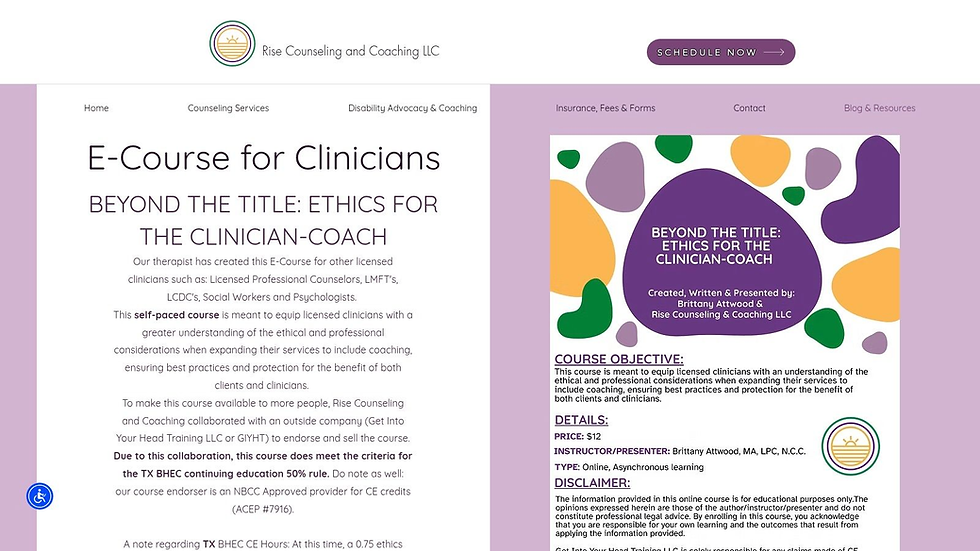
If you are a licensed clinician thinking about adding coaching to your work, start here before you market a single hybrid service.
Rise Counseling and Coaching’s Beyond the Title Ethics for the Clinician-Coach is the most strategically useful option on this list for counselors who need more than generic ethics hours. It addresses one of the messiest practical issues in private practice and telehealth. How do you expand services without confusing clients, drifting outside scope, or creating preventable documentation and boundary problems?
Created by Brittany Attwood, M.A., LPC, NCC, the course focuses on the places clinicians tend to get tripped up. Scope of practice. Dual relationships. Documentation. and more. That exploration, at an affordable price, is what makes it stand out. It is not coaching hype dressed up as ethics. It is ethical considerations applied to the exact decisions many counselors are trying to make right now- what do I need to know before I do this?
For clinicians who want a clearer conceptual foundation first, Rise also offers a helpful article on the differences between therapy and coaching for Texans seeking support.
Why this course earns the featured spot
Continuing education should increase awareness and reduce risk, not just award credit. This course does that well because it centers client welfare and licensure protection.
Master’s-level education remains the cornerstone of LPC preparation in most states, and post-graduate supervised requirements still vary widely. For example, Florida requires at least 1,500 supervised hours after the master’s degree plus state-specific coursework and the NCMHCE, while the District of Columbia requires 3,500 post-graduate hours including supervision requirements tied to an existing LPC, according to TherapyDen’s counseling statistics roundup (https://www.therapyden.com/blog/counseling-statistics). When licensure standards are already this rigorous, it makes sense to choose CE that helps with nuanced ethical judgment rather than surface-level inspiration.
What I like most about this training is its clinical realism. It reflects the questions that arise when a counselor wants to offer coaching ethically, while still seperately providing counseling services for trauma and other clinical issues.
Beyond the Title: Ethics for the Clinician-Coach is a Best fit for: Any Mental Health Clinicians (LPC, LCSW, LCDC, etc) considering therapy and coaching offerings or those needing Continuing education credits for license renewal, Supervisors supporting other clinicians, and counselors who want ethics CE that directly affects how they practice. Low cost and high quality continuing education content in an easy online format.
Trade-off: The self-paced format is flexible, but it is still self-paced. You have lifetime access to this course. However, if you learn best through live discussion or case consultation, add supervision or peer consultation alongside it.
Practical takeaway: If your biggest question is not “Can I offer coaching?” but “How do I do it without confusing clients or blurring my role?”, this is the right place to begin.
2. PESI

PESI is the platform many counselors use when they need range fast.
Its biggest strength is breadth. Trauma, CBT, DBT, grief, addiction, child and adolescent work, ethics, neurodiversity, and practice-oriented specialty topics all live in one ecosystem at PESI. If you are building a trauma-informed practice and want to compare multiple presenters before committing to a full certification pathway, PESI is a first stop.
Counselors exploring telehealth-friendly trauma work may also appreciate Rise’s article on whether online therapy is as effective as in-person care, especially when deciding which trainings translate well to remote practice.
Where PESI works well
PESI is useful when you are in a sampling phase. Maybe you know you want deeper trauma training but are still deciding between somatic work, cognitive approaches, dissociation-focused education, or EMDR-adjacent skills. The platform makes that exploration easier than most association portals.
Its course pages are straightforward about credits, presenter background, and delivery format. The mobile access is also practical for busy clinicians who chip away at CE between sessions, on travel days, or during lighter admin blocks.
Where to be careful
PESI’s biggest weakness is also its scale. Presenter quality varies. Some trainings are excellent and clinically rich. Others feel more promotional, more introductory than expected, or too broad to change practice.
A second caution is certification language. Some PESI offerings include branded certificates or advanced labels that sound substantial but do not necessarily carry the same weight as formal institute training, board recognition, or in-depth supervised consultation.
Best fit: Counselors who want flexible, topic-rich training for counselors across multiple specialties without committing immediately to one institute or model.
Trade-off: Strong marketplace, mixed depth. Use it for exploration, refreshers, and selected skills. Do not assume every badge or certificate equals advanced competency.
3. American Counseling Association Continuing Education
The ACA continuing education portal is where I point counselors who want CE that stays close to the profession itself.
That sounds simple, but it matters. Some CE platforms are broad enough that counseling-specific identity gets diluted. ACA keeps the focus on counselor ethics, multicultural practice, supervision, professional issues, and topics that map directly onto how counselors are trained and regulated.
Why ACA remains a smart anchor
The field depends on strong, standardized preparation. The American Mental Health Counselors Association was founded in 1976 and the National Board of Certified Counselors was established in 1982, both playing important roles in standardizing expectations for counselors and examinations such as the NCMHCE, according to TherapyDen’s counseling statistics roundup cited earlier in this article. ACA sits naturally in that professional ecosystem.
That is one reason its CE offerings feel grounded. If your goal is to stay aligned with counselor ethics and identity, this portal makes more sense than random third-party course libraries.
A few areas where ACA tends to be solid:
Refreshers: Helpful when you want current, counselor-specific framing rather than generic helping-profession courses.
Multicultural content: Useful for clinicians who want continuing attention to cultural identity, bias, and responsive care.
Conference learning: Good for counselors who learn best by pairing CE with networking and professional community.
The limitation
ACA is not where I would send someone looking for the deepest possible technical training in a specialty modality. You may find introductory or intermediate content, but for advanced trauma processing, couples method certification, or full modality immersion, specialty institutes usually go further.
Best fit: Counselors who want a stable professional home for general learning, multicultural competency, and profession-specific development.
Trade-off: Less extensive than the biggest CE marketplaces, but more aligned with the practicalities of counseling practice.
4. Beck Institute for Cognitive Behavior Therapy

When a counselor says they want cleaner case conceptualization, better session structure, and more confidence with anxiety and depression treatment, I think of the Beck Institute.
This is one of the clearest pathways for CBT training that feels methodical rather than pieced together. The Institute distinguishes between simple course completion and formal certification, which I appreciate. That transparency helps clinicians understand what they are earning.
What makes Beck Institute different
Some trainings for counselors leave you with useful techniques but a fuzzy framework. Beck Institute tends to do the opposite. It strengthens the underlying cognitive model so interventions make more sense session to session.
That matters in practice. A counselor who understands formulation can flex more effectively across panic, depression, suicidality, medical stress, and recurring negative beliefs. You are not collecting CBT worksheets. You are learning how to think in a more structured way.
This kind of training is valuable for clinicians who want to balance depth with practicality. CBT integrates well with agency settings, short-term work, insurance-based practice, and measurement-informed care.
The main trade-off
The Institute sits at a higher price point than broad CE platforms. If your immediate goal is to complete annual hours, this may feel like more investment than you need.
But if CBT is becoming a core clinical identity, the cost makes more sense. A coherent pathway is more efficient than buying scattered intro trainings from multiple providers and still feeling underprepared.
Tip for choosing advanced training: Pay attention to whether the provider clearly separates “course completion” from “certification.” That one detail often tells you a lot about the seriousness of the training model.
Best fit: Counselors who want rigorous CBT training with a recognizable educational pathway.
Trade-off: Premium pricing, but stronger structure and conceptual clarity than most general CE libraries.
5. The Gottman Institute Professional Training
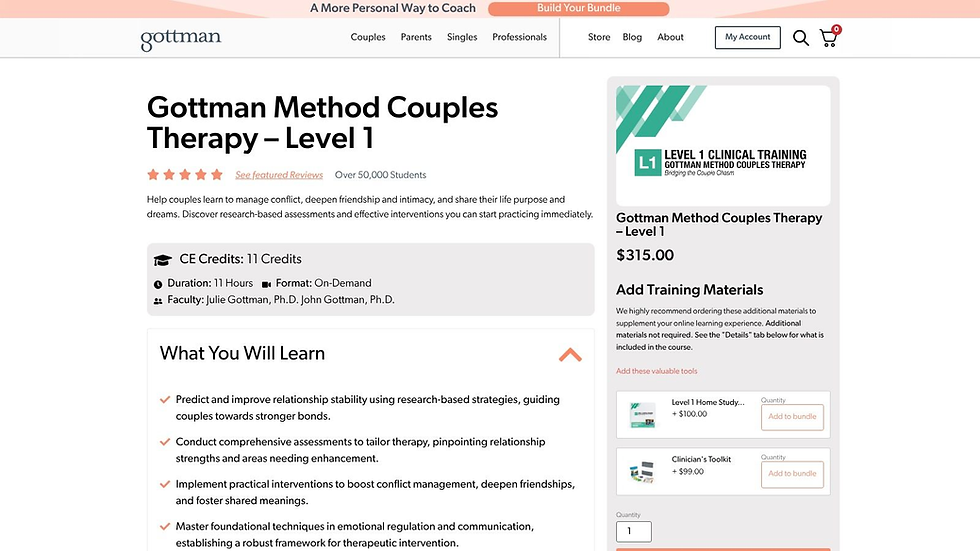
Couples work can expose gaps in training fast. A counselor may be excellent with individual trauma treatment and still feel unsteady when conflict escalates between partners in the room. The Gottman Institute’s professional training helps with that transition.
Its staged pathway is one of its best features. You can begin with Level 1 and build from there instead of guessing which couples model to commit to.
Why Gottman is practical
The Level 1 training offers a concrete entry point. The interventions are recognizable, structured, and easier to carry into session than more abstract couples theories. If you are starting to integrate couples work into an existing individual practice, that practicality matters.
The method also helps counselors who want more confidence in assessment and treatment planning with relationships. Instead of reacting to the loudest conflict in the room, you get a more stable framework for understanding patterns.
For trauma therapists, this can be useful. Many trauma cases involve relational injury, attachment strain, or couples stress around symptom management. Gottman training can expand your range without requiring you to abandon your existing orientation.
What to verify first
The CE sponsorship details matter. Counselors should confirm whether credits meet their state’s requirements and whether the course structure fits their board’s expectations.
It is also worth knowing that the advanced pathway requires ongoing investment. If you only need a basic foundation for occasional couples work, Level 1 may be enough. If you want couples therapy to become a major specialty, plan for additional time, cost, and consultation.
Best fit: Counselors adding couples work, clinicians who want stronger relationship tools, and therapists who prefer structured interventions.
Trade-off: Excellent practical starting point, but the full pathway requires sustained commitment.
6. IFS Institute
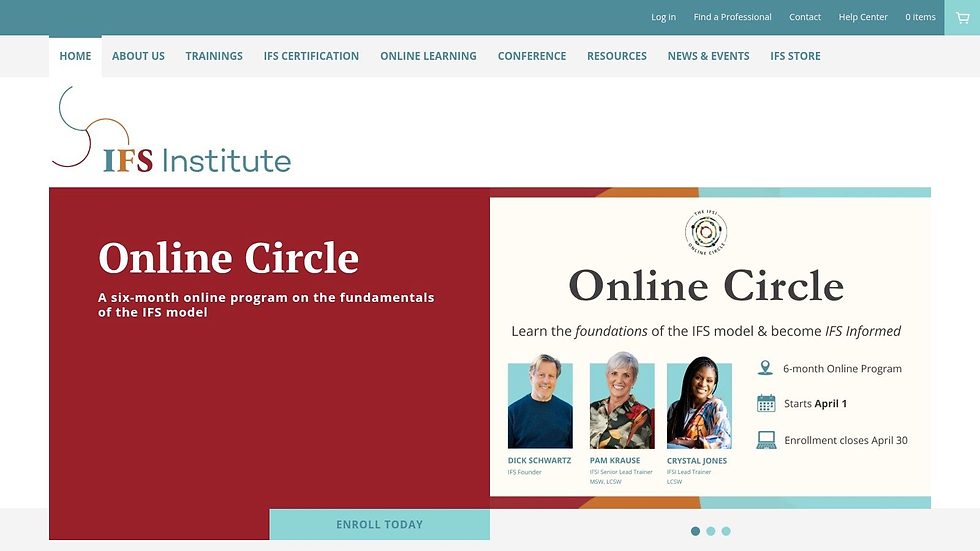
The IFS Institute is one of the most sought-after training paths for counselors who want a parts-based approach to trauma and protective systems.
IFS resonates with many clinicians because clients understand the language quickly. Parts that protect. Parts that carry pain. Internal conflict that is not pathology so much as adaptation. That framing can be relieving for trauma survivors.
For a brief overview of how parts-based work connects with trauma treatment, Rise has a useful article on trauma therapy techniques.
Why clinicians pursue IFS
The level-based model gives counselors a developmental path. It is not just a one-off workshop. The Institute also draws a large, engaged peer community, which matters more than people sometimes expect. Learning a modality is easier when you have colleagues who share the language and can discuss cases thoughtfully.
IFS also pairs well with trauma work because it offers a gentler route into internal experience. For counselors working with shame, ambivalence, dissociation, or long-standing inner conflict, that can be clinically useful.
Reality Check
Admissions can be competitive, and cost is significant. This is not a casual CE purchase.
It is also possible to become enchanted with the model’s language and start forcing every client into an IFS frame. Good training helps prevent that, but counselors still need discipline. The modality should serve the client, not the other way around.
Best fit: Trauma therapists and depth-oriented counselors who want a structured, parts-based clinical model.
Trade-off: High demand and strong clinical appeal, but limited access and substantial investment in cost and time.
7. Somatic Experiencing International
Some counselors reach a point where purely cognitive training no longer feels sufficient for the trauma work in front of them. That is when Somatic Experiencing International enters the conversation.
SEI offers a multi-year, module-based path focused on body-based stabilization and trauma physiology. It is not a quick add-on. That is both the challenge and the value.
What SEI offers that shorter CE cannot
The training slows counselors down. Instead of racing toward insight or narrative processing, it trains attention to activation, regulation, pacing, completion, and embodied cues.
That can be a major strength with complex trauma, chronic stress physiology, and clients who become overwhelmed by approaches that move too quickly into content. It also complements modalities like EMDR and IFS well when a clinician wants more precision around nervous system responses.
One practical note from the provider’s own training information is that some components include consults and personal sessions, and CE eligibility may vary by component. That is worth reviewing carefully before enrolling.
The main drawback
This path asks for time, money, and patience. It is not ideal for counselors who need quick CE or who are still unsure whether body-based work fits their style.
There is also a skills-transfer issue with any long training. Research on counselor training adoption found that only 39 to 41 percent of attendees completed follow-up assessments after initial workshop training, and lack of time was the most frequently cited barrier to adoption, according to a study available through PubMed Central (https://pmc.ncbi.nlm.nih.gov/articles/PMC1989156/). A long program only pays off if you build practice, consultation, and integration time into your calendar.
Good training changes practice only when counselors create room to use it. Protect implementation time before you buy another course.
Best fit: Clinicians who want deeper body-based competency and are prepared for a longer developmental process and higher cost per CE hour.
Trade-off: Rich learning, heavy commitment. High cost upfront.
8. NAADAC Education
Many counselors who do not identify as addiction specialists still treat substance use every week. That is why NAADAC’s education resources deserve a place on this list.
Anxiety, trauma, chronic stress, family conflict, and substance use show up together. If your training has not kept pace with that reality, case formulation becomes thinner and treatment planning can miss important drivers.
Where NAADAC adds real value
NAADAC is useful when you need addiction content that goes beyond basic awareness. It offers specialty trainings and a large education library that can support both focused upskilling and ongoing maintenance of competence.
This is also a strong fit for clinicians in community mental health, integrated settings, or private practice where co-occurring presentations are common but formal addiction training has been limited.
Another benefit is that NAADAC understands credentialing and professional regulation. That tends to show in how education is organized and described.
A practical limitation
The library is addiction-centered by design. If your needs are trauma, couples, or coaching ethics, another provider may be a better primary home.
Still, many counselors underestimate how often addiction knowledge improves work outside formal SUD treatment. Better understanding of relapse patterns, motivational issues, and co-occurring symptoms can sharpen therapy across settings.
Best fit: Counselors treating co-occurring substance use, seeking addiction-focused CE, or broadening competency beyond general mental health work.
Trade-off: High value within its niche, less useful as an all-purpose training hub.
9. CE4Less
Not every year is a “build a new specialty” year. Sometimes you need efficient, affordable, compliant CE that fits around a full caseload. CE4Less is strong in that lane.
It is one of the better options for counselors who want year-round access, fast certificate turnaround, and a straightforward subscription model.
Why CE4Less makes sense
The value is convenience. Text courses, webinars, on-demand options, and renewal reminders make it easier to stay current without overcomplicating the process. For counselors juggling clinical work, family life, and supervision responsibilities, that simplicity matters.
This is also the kind of platform that works well for mandated topics, ethics refreshers, and filling in annual CE gaps when a specialty institute would be excessive.
What it will not replace
It is not a substitute for thorough specialty training. A large library is useful, but library size does not equal advanced clinical development.
That point shows up in broader adoption data too. Acrosanalytics s implementation, only 25 percent of employees actively use analytical tools despite organizational investment, with barriers including lack of proper training, data quality issues, budget constraints, and usability concerns, according to BARC’s infographic on BI and analytics adoption strategies (https://barc.com/infographic-bi-analytics-adoption-strategies/). The same lesson applies to CE libraries. Access alone does not create meaningful practice change.
Best fit: Counselors who want flexible, economical CE for renewal and general professional maintenance.
Trade-off: Excellent convenience, limited depth for true specialization.


Comments