
_edited.png)
Mental Health Groups for Adults: Find Your Support

Some nights you close the laptop, put the dishes away, and realize you haven’t had one honest conversation all day. You may be functioning. You may be caring for other people, showing up to work, answering texts with “I’m fine.” But inside, you feel tired, disconnected, or stuck in the same emotional loop.
That’s often the moment people start searching for mental health groups for adults.
Not because they want to talk in front of strangers right away. Usually it’s because they want relief. They want to feel less alone. They want to know whether other adults also carry trauma, grief, anxiety, chronic illness, identity-based stress, or the heavy feeling of always having to hold it together.
If that’s where you are, your reaction makes sense. Reaching for support can feel vulnerable, especially if you’ve been disappointed before or if you’re not sure what group therapy even looks like. Still, many adults are turning toward care. In 2023, nearly one in five U.S. adults, or about 59.2 million people, received mental health treatment or counseling, which shows how common seeking support has become in everyday life (Statista data on U.S. adults receiving mental health treatment in 2023).
That doesn’t erase the fear. It does remind us that needing support isn’t unusual. It’s human.
You Are Not Alone Finding Strength in Community
A lot of adults arrive at group therapy after trying to manage alone for a long time.
Maybe you tell yourself your problems “aren’t serious enough.” Maybe you’ve become so used to pushing through that rest, openness, and support feel unfamiliar. Or maybe you’ve talked with friends, but the conversation stays on the surface because you don’t want to burden anyone.

Group therapy can interrupt that isolation in a gentle way. You don’t walk in expected to perform or tell your whole life story. You enter a space where other adults also know what it’s like to feel overwhelmed, numb, ashamed, exhausted, or uncertain about how to heal.
What many people notice first
The first shift is often simple. Someone says something you’ve never said out loud, but you’ve felt for years.
That moment matters. It can soften the belief that you’re strange, broken, or failing at life. It can help your nervous system settle enough to consider a new possibility, which is that healing may happen more easily in connection than in isolation.
Sometimes the first benefit of a group isn’t advice. It’s relief.
Mental health groups for adults come in different forms. Some focus on support and shared experience. Some teach coping tools. Some go deeper into patterns in relationships, boundaries, grief, trauma, or emotional regulation. Some are offered virtually, which can make participation easier for adults across Texas who need privacy, convenience, or a way to access specialized care without a long drive.
Hope often starts small
You may not feel ready. That’s okay.
Readiness doesn’t always look like confidence. Sometimes it looks like searching, reading, and wondering whether this could help. That kind of curiosity counts.
A useful action item for today is this: notice any feeling of hope or curiosity that comes up while you read. You don’t need to force a decision. Just pay attention to the part of you that wants something gentler and more connected.
Understanding the Core of Group Therapy
Many people hear “group therapy” and picture an unstructured circle where everyone talks over each other. That image keeps some adults from getting support that might fit them well.
A better comparison is a guided hike. The terrain may be hard. Other people are on the trail with you. But a trained guide helps the group move safely, stay oriented, and make use of the journey.
What makes a therapy group different
A professionally facilitated group isn’t the same as venting with friends or chatting in an online forum.
It has a purpose. It has boundaries. It has a therapist who watches for safety, pacing, participation, and group dynamics.
Here’s what that usually means in practice:
Clear structure: Sessions usually start and end on time, follow an intentional format, and center on shared goals.
Confidentiality expectations: Members are asked to protect one another’s privacy.
Clinical guidance: A licensed therapist helps the group stay respectful, useful, and emotionally safe.
Growth-oriented conversation: The goal isn’t just to talk. The goal is to build insight, practice skills, and support healing.
What the therapist is doing
The therapist isn’t there to dominate the room. They’re there to facilitate.
That includes noticing when someone needs more space, when a topic needs grounding, or when the group would benefit from slowing down. In a trauma-informed setting, the therapist also helps reduce pressure, increase predictability, and make room for choice.
Practical rule: A good group should feel guided, not chaotic.
Some groups are more educational. Others focus on processing emotions and relationships in real time. In both cases, the therapist helps members engage in a way that is thoughtful and contained.
What group therapy is not
It’s not a place where you have to be “good at talking.”
It’s not a competition over who has had it worse. And it isn’t a setting where you must reveal everything immediately to belong.
If you’re quiet at first, that’s normal. If you need time to trust, that’s normal too. Many adults benefit from listening in the beginning and noticing how the group works before speaking much.
That’s one reason mental health groups for adults can be so effective. They offer a shared space for healing, but they also respect pacing. You get support from the therapist, from the structure, and from the presence of others who are also doing honest work.
Finding the Group That Fits Your Needs
Not every group is trying to do the same thing. That’s good news.
If you’ve ever thought, “I’m interested in group therapy, but I don’t know what kind,” you’re already asking the right question. The best fit depends on what you need most right now. Do you want information, coping tools, emotional support, deeper relational work, or a group designed around a specific experience such as trauma or chronic illness?
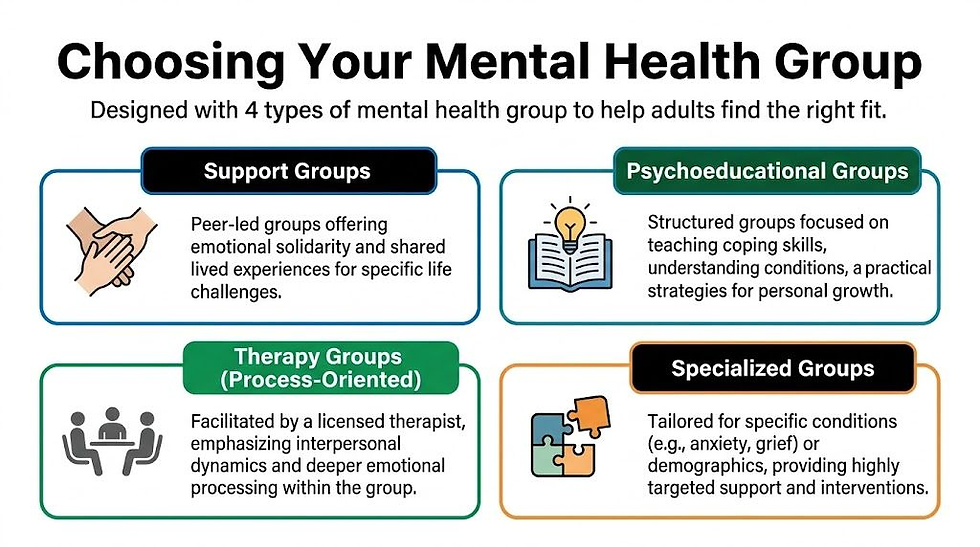
Four common group types
One helpful place to start is by separating group formats into broad categories.
Psychoeducational groups are built around learning. They use a structured curriculum to teach information and practical strategies. As described in this overview of psychoeducational groups as a structured modality, they focus on knowledge transfer and can cover topics like trauma responses, relapse prevention, or coping skills.
Support groups center on shared experience and mutual encouragement. These can be comforting and grounding, especially when you need connection with people who understand a life challenge from the inside.
Process-oriented or skills based therapy groups tend to go deeper. They often explore emotions, patterns in relationships, tangible coping skills, communication, and what happens between group members in the moment. You often work with a licensed therapist.
Specialized groups are designed for a specific concern or population. That might include adults living with chronic illness, trauma survivors, or people looking for a setting that better reflects their cultural identity or lived experience.
A simple comparison tool
Group Type | Primary Goal | Best For You If... |
Support Groups | Connection and shared understanding | You want to feel less alone and hear from others with similar life experiences |
Psychoeducational Groups | Learning about symptoms, patterns, and coping tools | You like structure and want concrete information you can apply between sessions |
Therapy Groups (Process-Oriented or Skills based) | Emotional insight and relational growth | You want to explore recurring patterns, vulnerability, and interpersonal healing while learning tangible skills |
Specialized Groups | Targeted support around a specific issue or identity | You need a group designed around trauma, chronic illness, identity, or another focused concern |
How to choose without overthinking it
If you’re overwhelmed by options, try matching the group to your current need instead of trying to predict your forever fit.
Ask yourself:
Do I need understanding first: If yes, a support group may help or reach out to a therapist who specializes in working with your area for individual online counseling.
Do I want practical tools: A psychoeducational or skills-based group may fit.
Am I ready for deeper emotional work: A process group r specialized group topic may be appropriate.
Do I need care that reflects a specific life experience: A specialized group may feel safer and more relevant.
You can also review current options through therapy groups in Texas if you’re looking at therapist-led virtual offerings and want to see how groups are described.
The right group doesn’t have to be perfect. It needs to be clear enough, safe enough, and relevant enough that you can begin.
How Shared Experiences Accelerate Healing
One of the most surprising things about group therapy is that healing often happens in moments that look ordinary from the outside. A nod from another member. A sentence that lands. A realization that your private fear isn’t private at all.

Relief through recognition
Many adults carry a silent belief that they are the only one reacting this way.
Then someone in the group says, “I keep canceling plans because I’m overwhelmed,” or “I look fine at work and fall apart at home,” and the room softens. That shared recognition can reduce shame quickly because it replaces isolation with context.
This is one reason mental health groups for adults can move people forward in a different way than solitary reflection. You don’t just think new thoughts. You experience yourself differently in the presence of others.
Helping others can help you
Group members often expect to receive support. They’re less prepared for how meaningful it feels to offer it.
When you tell another person, “What you said makes sense,” or “I’ve felt that too,” you’re not only helping them. You’re practicing compassion, perspective, and emotional presence. Many adults begin to speak to themselves more kindly after learning how naturally they offer care to someone else in the room.
When hope feels hard to generate alone, borrowing it from a group can be enough to keep going.
Progress becomes visible
In individual therapy, growth can feel quiet. In a group, you may witness it.
You see someone set a boundary they couldn’t name a month ago. You hear a member talk with less self-blame than before. You notice your own body relax because the group has become familiar.
That kind of change is easier to believe when you watch it happen in real time.
A short video can also help make the experience more concrete:
The group becomes part of the treatment
The conversation itself matters, but so does the environment.
A well-run group gives you repeated chances to practice listening, speaking, receiving feedback, tolerating discomfort, and staying present with emotion. Those are real-life skills. They don’t only help inside the session. They follow you into relationships, work, family, and the way you relate to yourself when things get hard.
Your Practical Steps to Finding a Safe Space Online
Looking for a virtual group can feel confusing at first because search results often mix together peer communities, social support spaces, and formal therapy groups. If you’re hoping for professional care, it helps to narrow your search quickly.
A real challenge for many Texans is locating therapist-led, HIPAA-compliant virtual groups that focus on trauma or chronic illness rather than general peer support alone. This need is described in NAMI’s overview of support group options and the gap in professionally facilitated virtual care.
Start with your goal
Before you compare websites or schedules, write down what you want help with.
Keep it plain. You might write:
I want to feel less alone with trauma symptoms.
I need support living with chronic illness and the emotional toll of it.
I want a group where I don’t have to explain my background to feel understood.
I’m looking for tools, not just a place to vent.
This step matters because “support” can mean very different things. A group that is wonderful for grief may not fit someone looking for trauma processing. A broad peer community may not meet the needs of someone who wants a clinician guiding the work.
Know what to look for in an online listing
Once you know your goal, read group descriptions closely.
Look for language that answers these questions:
Who leads it: Is the group facilitated by a licensed therapist?
Who it’s for: Does it specify adults, concerns addressed, or identity-specific focus?
How it works: Is it educational, supportive, process-oriented, or skills-based?
How privacy is handled: Does the practice mention secure telehealth or HIPAA-compliant care?
How payment works: Are insurance and self-pay options explained clearly?
If a listing stays vague, it’s okay to ask direct questions before joining.
Know when it starts and ends: Virtual mental health groups needs to have clear expectations for frequency of meetings and duration. A great example is the virtual groups Rise Counseling and Coaching LLC offer. They are offered quarterly (4x a year) only, meet weekly, and are typically 8 weeks in length.
Ask practical questions early
Many adults wait until they’re emotionally invested before asking about logistics. It’s easier to ask up front.
A few useful questions include:
What is the purpose of this group
Is it open or closed to new members
What telehealth platform do you use
Do you accept my insurance for group therapy
What is the self-pay fee if I’m out of network
What should I expect in the first session
One option Texans can review while comparing services is this page on online counseling services at Rise Counseling and Coaching LLC in Texas, which explains a telehealth-based practice model and can help you understand what to look for when evaluating virtual care.
Check the online format itself
Virtual therapy works best when the setup supports privacy and steadiness.
Try to confirm:
Private space: Can you join from a room where others won’t overhear?
Reliable device: Will your phone, tablet, or computer handle the session comfortably?
Audio comfort: Headphones can help with privacy and focus.
Emotional exit plan: What helps you regulate after group ends. A walk, tea, journaling, or quiet music can help.
What to prioritize first: safety, fit, and clarity. Convenience matters, but those three matter more.
Understand insurance without getting overwhelmed
Insurance language can feel intimidating, but you don’t need to master it all.
Call the number on your insurance card and ask whether group therapy is covered for telehealth behavioral health services. Ask whether you need a deductible, copay, or authorization. If a practice offers self-pay, ask for the fee and whether they provide documentation you can submit for out-of-network reimbursement if applicable.
You don’t need to solve everything in one day. One action is enough. Choose one group you’re considering and send one inquiry email or contact form today.
Why Inclusivity in Mental Health Groups Matters
A group can be clinically sound and still feel unsafe if it ignores the realities members carry into the room.
For trauma survivors, predictability, choice, and emotional pacing matter. For adults from marginalized communities, safety also depends on whether the space understands identity, power, and the effects of systemic harm. For disabled adults or people living with chronic illness, access and advocacy aren’t side issues. They shape whether care is usable at all.
What trauma-informed care looks like in a group
A trauma-informed group doesn’t assume everyone feels safe just because the therapist is kind.
It pays attention to pacing. It avoids coercion. It offers clear expectations and respects that people may need options around how and when they participate.
In practice, that might look like:
Choice in participation: You may be invited, not pressured, to share.
Consistent structure: Predictable openings and closings can reduce anxiety.
Grounding support: The facilitator helps members return to the present when distress rises.
Respect for boundaries: Members aren’t pushed to disclose more than they want.
Cultural sensitivity is part of safety
Cultural sensitivity in therapy means more than being “welcoming.”
It means the group doesn’t treat race, ethnicity, sexuality, disability, religion, or family culture as irrelevant background details. Those experiences can shape stress, trust, grief, body responses, access to care, and what healing even looks like.
There is a documented need for care that combines cultural sensitivity with disability advocacy in virtual settings, especially for adults whose identities intersect in ways that are often overlooked, as discussed in this article on mental health organizations and gaps in inclusive support.
What to listen for when you ask questions
If you’re screening a potential group, notice whether the answers reflect real understanding.
You might ask:
How do you create safety for trauma survivors
How does the group address cultural identity and lived experience
What accessibility considerations are available for disabled participants
How do you handle microaggressions or harmful comments if they happen
A thoughtful response doesn’t need to sound polished. It should sound specific.
The most healing group is often the one where you don’t have to split yourself into acceptable pieces to stay in the room.
When a group is both trauma-informed and culturally responsive, adults often spend less energy protecting themselves and more energy doing the actual work of healing.
Easing into Your First Group Therapy Meeting
The first meeting is usually less dramatic than people fear.
Most virtual groups begin with simple orientation. You log in, the therapist welcomes everyone, and there’s a brief review of the group’s purpose, expectations, and confidentiality. You’re not dropped into deep sharing without context.
What the opening often feels like
There may be short introductions. Sometimes members share only their first name and a few words about why they came. Sometimes the therapist offers a check-in prompt such as how you’re arriving today or what you hope to get from the group.
If you feel awkward, that doesn’t mean you’re doing it wrong. Nearly everyone feels some version of that at first.
You are allowed to go slowly
One of the biggest misconceptions is that joining means you must immediately speak at length.
You don’t. In many groups, listening is a valid form of participation, especially early on. You may decide to contribute one sentence, or notice what topics resonate.
A first session often includes:
Ground rules: privacy, respect, turn-taking, and group norms
Orientation: how the group will run and what kind of participation is invited
A manageable discussion: enough to engage, not enough to flood you
Closing support: the therapist helps members transition out of the session
What helps before you log in
A few small preparations can make the first meeting easier.
Sit somewhere private. Keep water nearby. Use headphones if that helps. Plan something calming for afterward so you’re not rushing straight into errands or work.
If your heart races before the session starts, that’s understandable. New spaces can activate old fears. You don’t need to eliminate the anxiety before showing up. You only need enough steadiness to click “join.”
Answering Your Questions About Group Therapy
Even after learning the basics, many adults still have a few private worries. Those worries are common, and they deserve clear answers.
Is group therapy confidential
Therapists set confidentiality expectations at the beginning and remind members to protect one another’s privacy. In a virtual setting, privacy also depends on each member joining from a secure, private space.
Confidentiality matters because group therapy is treatment, not casual conversation. That distinction is part of why therapist-led groups matter. While 52.1% of adults with any mental illness received some form of treatment in 2024, a significant gap remains, and therapist-led groups are part of professional care for people who need evidence-based support (NIMH mental illness statistics and treatment data).
What if I’m too anxious to talk
You can still attend.
Many people speak very little in their first meeting. A skilled facilitator won’t force disclosure. Over time, safety often grows through observation, routine, and hearing others speak openly.
How long do people stay in group therapy
That depends on the group model and your goals.
Some groups run for a set number of sessions. Others continue over time. If you’re unsure, ask whether the group is time-limited or ongoing and how progress is reviewed.
How is a therapist-led group different from a peer group
Both can be valuable, but they aren’t interchangeable.
A peer group is often built around mutual support and lived experience. A therapist-led group includes clinical assessment, structured interventions, and a facilitator trained to manage safety, pacing, and therapeutic process. If you want a stronger sense of how online therapy works, this article on common questions about online therapy can help.
What if I choose the wrong group
Then you reassess.
Joining one group doesn’t trap you forever, but be aware of the commitment you make. Some groups require you to consent to attending every session or risk being charged as a self-pay client even if you don't show--know the attendance and cancellation policy early on. Sometimes though, the first step is gathering enough experience to learn what helps you feel supported, challenged, and understood.
If you’ve been waiting for a sign that it’s okay to seek connection, this is it. Support doesn’t have to begin with certainty. It can begin with a question, a message, or one first meeting.
If you’re ready to explore a therapist-led virtual group or individual therapy option in Texas, you can learn more about services or reach out through the Rise Counseling and Coaching LLC contact page. A simple next step is enough. Send one question, ask about current group availability, and let that be the start.


Comments